Thursday, May 22, 2014
2014 Tour Day Thirteen


2014 Tour Day Twelve
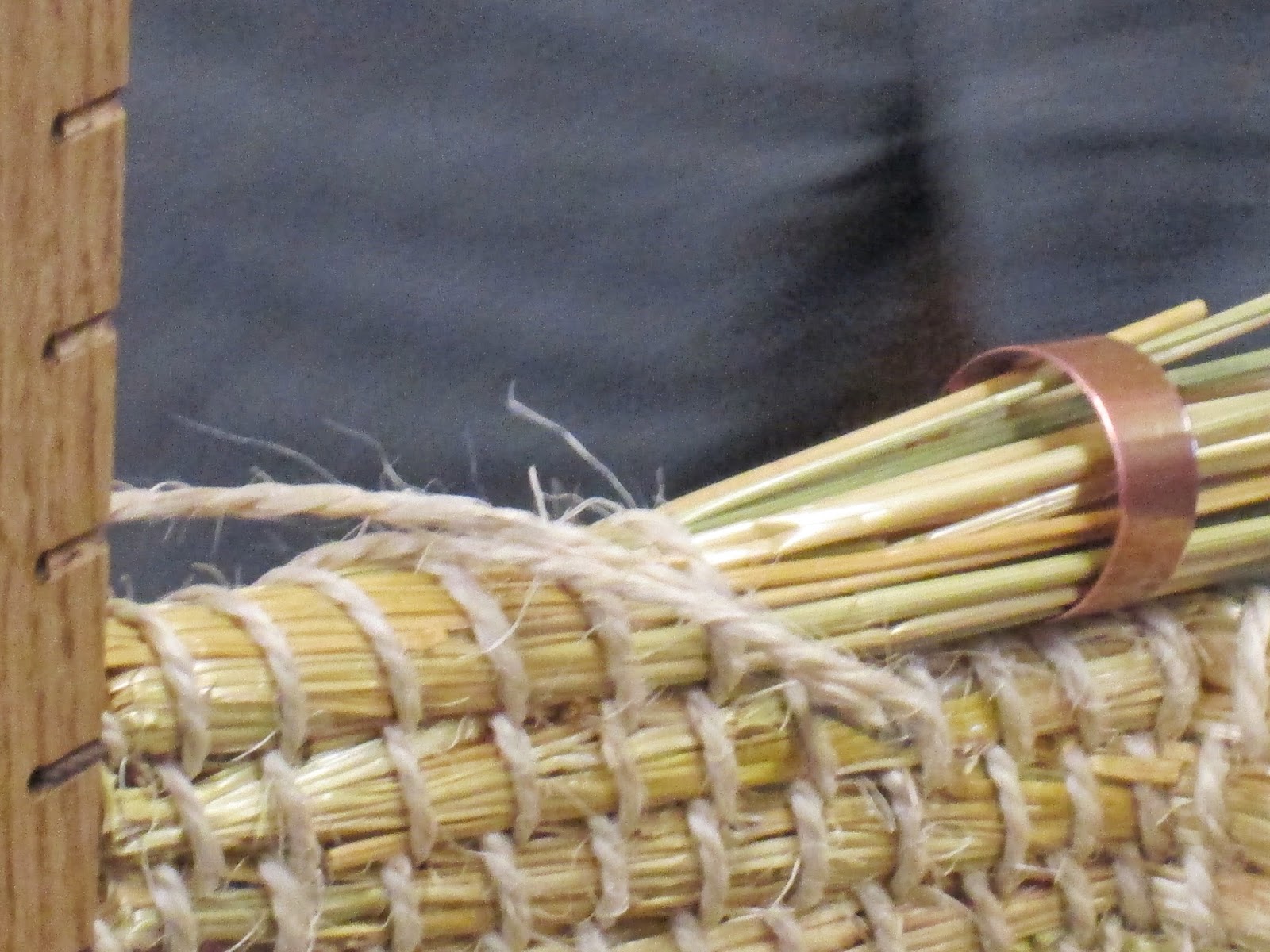
Orkney is brimming with makers of jewelry, knitting, felting, weaving, ceramics, musical instruments, and chairs. Jackie and Marlene Miller have run Scapa Crafts for 20 years. They make chairs of oatstraw, sisal, and wood.
2014 Tour Day Eleven

Wednesday, May 21, 2014
2014 Tour Day Ten
 |
| Smoo Cave |
Tuesday, May 20, 2014
2014 Tour Day Nine
 You may have visited a stone circle somewhere in the world. There is nothing like visiting a stone site with an archeolgist such as Margaret Curtis. She has lived in the area and worked on Callenish Isle of Lewis for over 30 years. She has a new book just out with discoveries made from aerial photographic examination of the site. Despite what felt like gale force winds, we dutifully followed Margaret
around the formation as she engaged and enlighted us with her
enthusiastic and informative insight into the mysteries of the stones.
You may have visited a stone circle somewhere in the world. There is nothing like visiting a stone site with an archeolgist such as Margaret Curtis. She has lived in the area and worked on Callenish Isle of Lewis for over 30 years. She has a new book just out with discoveries made from aerial photographic examination of the site. Despite what felt like gale force winds, we dutifully followed Margaret
around the formation as she engaged and enlighted us with her
enthusiastic and informative insight into the mysteries of the stones.Monday, May 19, 2014
2014 Tour Day Eight

At an unlikey gallery, the upstairs of the An Clachan grocery store in Leverburgh on the southern tip of Harris, is displayed a wonderful labour of love. Gillian Scott-Forrest instigated the Harris Millenium Project. A series of hangings was designed, one for each part of the island.
The tweed fabric and the wool yarn used for the pictorial embroidery was hand dyed using plant dyes. Of the 1600 people living on Harris, 90 were involved in the project. The images on each hanging depict both history and current events from each area of the island. Each of the 8 panels are 5' x 2 1/2'.
Sunday, May 18, 2014
2014 Tour Day Seven

Folks ask why I lead tours of Scotland in the spring. The glory of Highlands and Islands in springtime is one of the reasons.
Trish Norman performed a house concert for us last night. Enjoy her song about flax and linen as you watch today's video.
2014 Tour Day Six
 |
| The work of Elaine Lindsey |
I play the traditional Scottish tune, "Harvest Home" hornpipe to accompany the "making" in the following video.
Saturday, May 10, 2014
2014 Tour Day Five
Dundee lies on the River Tay and was once known for Jute, Journalism, and Jam. Dundee is now home to two fine museums. Discovery Point about Admiral Scott's polar expeditions and his ship, the "Discovery and Verdant Works Jute Mill Museum.
In it's heyday, Dundee was called “Jutopolis.” Over 50,000 workers worked in the jute mills. Verdant Works Jute Mill, built in 1833 , was the 16th largest of 61 milles. The last of the jute mills closed in 1997. Verdant Works is the focus of today's video.
Read more information and see many photos about both museums, in 2011 Day 5 blog post.
In it's heyday, Dundee was called “Jutopolis.” Over 50,000 workers worked in the jute mills. Verdant Works Jute Mill, built in 1833 , was the 16th largest of 61 milles. The last of the jute mills closed in 1997. Verdant Works is the focus of today's video.
Read more information and see many photos about both museums, in 2011 Day 5 blog post.
2014 Tour Day Four
We were lucky to be here the night the Scottish folk band "Breabach" was playing. They are gaining an international reputation with recent tours to Australia and New Zealand. James Lindsay, the son of our he teacher for the straw weaving workshop on Day 6 is the bass player in the band. So it was a real treat to see the 5 member band perform live after hearing their recorded music on cd and on BBC Radio Scotland's "Travelling Folk" program.
Again for the moment, my video of a tune they performed is not uploading properly. Once I can upload you will get to see and hear Breabach right here. Until then, visit their website above and enjoy photos from Edinburgh below.-Nadine
 |
| Edinburgh Botanic Garden Glass Houses |
 |
| Gate to Holyrood Palace |
 |
| Edinburgh Castle |
 |
| View from Arthur's Seat |
 |
| Walter Scott Monument |
2014 Tour Day Three
My new video about the Falls of Clyde at New Lanark is not uploading properly. Until I can troubleshoot the issue, below is information and photos from a previous visit to New Lanark.--Nadine
New Lanark World Heritage Site is the site of a former mill where cotton was spun. Today, in one of the restored mill buildings, there is a small production of wool yarn being spun on a large spinning mule for the sake of education and for profit.
The community was built below three falls on the River Clyde in the late 1700’s by David Dale. The mill ran on power generated by the falls. Today New Lanark still produces hydropower that runs the community, with enough left over to sell back to the power grid.
  The mill was purchased and run by Robert Owen from 1800-1825. He was a social reformer and forward thinker far ahead of his time. He ideas were not popu
 lar with other mill owners. But his efforts gave him the title “father of trade unionist movement” in Scotland. He banned children from under age 10 from working in the mill. He started the first nursery school in the UK. Children from ages 2-9 went to school while their parents and siblings worked in the mill. Once children reached age 10, they worked in the mill and then attended classes at night. Mr. Owen treated his own 7 children no differently than he treated the children of the mill workers.

The school was built by money generated from the company store which was run as a cooperative. New Lanark was the first cooperative that lead to the foundation of The Co-op, a grocery store still thriving around the country today. In school not only were reading, writing, and arithmetic taught, but the children studied dancing, music, and nature studies.


 The workers lived in buildings just across from the mill. A family of 10 may share one room, but they were warm, well fed, and had health care provided by the mill doctor. The work day started at 6 a.m with a breakfast break at 9 a.m. and lunch break in the middle of the afternoon. The work day ended at 7pm. The mill ran 6 days a week and was closed on Sunday. They produced 50,000 miles of cotton per week. The mill operated until 1968 when it could not operate profitably. The mill buildings sat empty and fell into disrepair from the elements and vandalism. A foundation saw the value in restoring the site and started the vast restoration of the mill in the 1970’s. The restoration still continues today. The newest addition is a roof garden on top of one of the mill buildings.
The site is a glorious example of public and private cooperation to preserve an important part of Scottish history and t o educate generations to come. Today 150 people live on the site. Many visitors may only take the Annie McLeod ride. But I encourage you visit the school building, visit Robert Owen's house, spend time looking through the exhibits in Mill buildings 1 and 2 and the housing block, and take the hike to all 3 water falls.
New Lanark World Heritage Site is the site of a former mill where cotton was spun. Today, in one of the restored mill buildings, there is a small production of wool yarn being spun on a large spinning mule for the sake of education and for profit.
The community was built below three falls on the River Clyde in the late 1700’s by David Dale.
 The mill ran on power generated by the falls. Today New Lanark still produces hydropower that runs the community, with enough left over to sell back to the power grid.
  The mill was purchased and run by Robert Owen from 1800-1825. He was a social reformer and forward thinker far ahead of his time. He ideas were not popu
 lar with other mill owners. But his efforts gave him the title “father of trade unionist movement” in Scotland. He banned children from under age 10 from working in the mill. He started the first nursery school in the UK. Children from ages 2-9 went to school while their parents and siblings worked in the mill. Once children reached age 10, they worked in the mill and then attended classes at night. Mr. Owen treated his own 7 children no differently than he treated the children of the mill workers.
The school was built by money generated from the company store which was run as a cooperative. New Lanark was the first cooperative that lead to the foundation of The Co-op, a grocery store still thriving around the country today. In school not only were reading, writing, and arithmetic taught, but the children studied dancing, music, and nature studies.


 The workers lived in buildings just across from the mill. A family of 10 may share one room, but they were warm, well fed, and had health care provided by the mill doctor. The work day started at 6 a.m with a breakfast break at 9 a.m. and lunch break in the middle of the afternoon. The work day ended at 7pm. The mill ran 6 days a week and was closed on Sunday. They produced 50,000 miles of cotton per week. The mill operated until 1968 when it could not operate profitably. The mill buildings sat empty and fell into disrepair from the elements and vandalism. A foundation saw the value in restoring the site and started the vast restoration of the mill in the 1970’s. The restoration still continues today. The newest addition is a roof garden on top of one of the mill buildings.
The site is a glorious example of public and private cooperation to preserve an important part of Scottish history and t
 o educate generations to come. Today 150 people live on the site. Many visitors may only take the Annie McLeod ride. But I encourage you visit the school building, visit Robert Owen's house, spend time looking through the exhibits in Mill buildings 1 and 2 and the housing block, and take the hike to all 3 water falls.
Thursday, May 8, 2014
2014 Tour Day Two
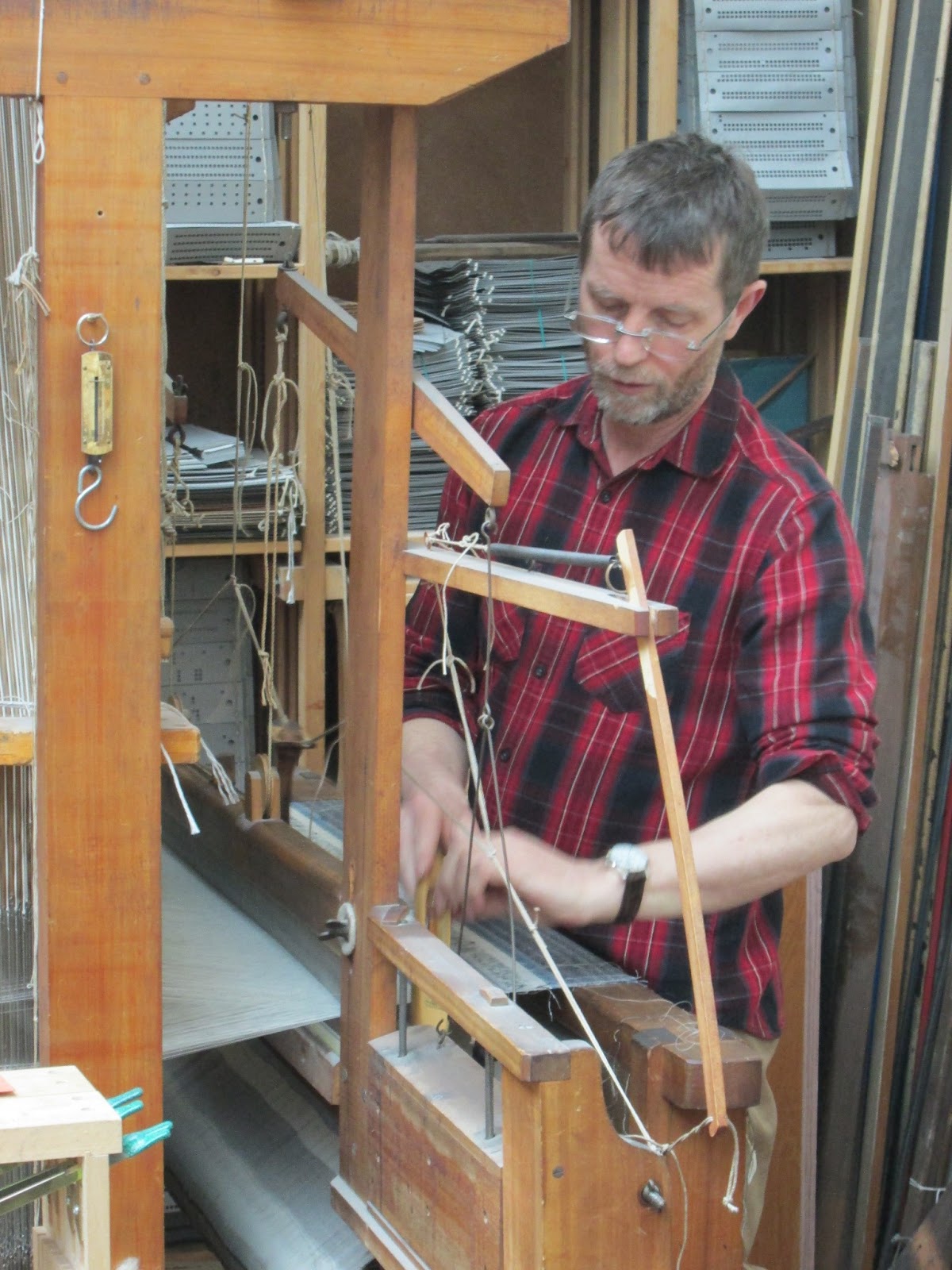 |
| Dan Coughlan |
The Paisley Museum houses a fine collection of Paisley shawls and an excellent display of the equipment used in the trade. Dan Coughlan, weaver, loom technician and curator showed us how some of the equipment worked.
To read a detailed account of the Paisley Museum and other venues we visit in Paisley, see the blog post from 2012, Day 2
Sunday, May 4, 2014
2014 Tour Day One
 |
| Hairy coo |
Christine Macleod has been the head weaver in the cottage since the 1990's. In a typical weaver's cottage, the man wove on the loom which occupied the lower level of the house. The women and children did the spinning, supplying the "copps", the yarn for the weft of the weaving. In the 1800's the weavers took on contract work, getting the warp and weft materials from a "jobber" and weaving to their specifications. Most weaving shifted from hand loom cottage industry to power loom weaving done in factories in the second half of the 1800's. A very small number of handloom weavers continued on into the 1900's with speciality work. On of the last ones, Willie Meikle, wove tartan and double sided cloth into the middle of the 20th century. His loom, over 200 years old, is the one still used in the Weaver's Cottage.
"Jenny Dang the Weaver" is a traditional Scottish tune I played on my fiddle for the video below.
Monday, May 13, 2013
Day Fourteen, 29 April 2013
The final day of the tour takes us from Inverness via Stirling, back to Glasgow where we started. 2013 will stand out as the tour we traveled on the most B roads, the latest arrival of spring, the most prompt group of travelers to date, and a plethora of newborn lambs, After 6 tours, give me a week to regroup, and I'm looking forward to next year. Join me April 29-May 12, 2014!
.jpg) |
| Scotland is a cheese lover's paradise. We stopped at the House of Bruar food hall to purchase picnic food. |
.jpg) |
| Rudy has been weaving on the Unicorn tapestry project at Stirling Castle for 7 years |
.jpg) |
| A section of the last tapestry being woven at the castle. |
.jpg) |
| When we visited the castle in 2012, this piece had been been started Oct 2011. See the ink around on the warps with cartoon in the background. This is the same section as the now woven piece above. |
.jpg) |
| The color print out from the final piece being woven . Only fragments of the 7th original tapestry remained at the Cloisters Museum in New York. Historic Scotland wanted an entire piece, so the tapestry titled "Sight" from the Cluny Museum's set of Unicorn tapestries was used for this design. |
.jpg) |
| The weaving studio was built at Stirling Castle for the 13 year long project. Some of the tapestries were woven at West Dean Tapestry Studio in England. |
.jpg) |
| Sharolene with the animated castle guide |
.jpg) |
| "The Start of the Hunt" now hangs with the other completed tapestries in King James V Royal Palace at Stirling. The tapestries were woven for the refurbishing of the palace. There are records King James V had many tapestries in the palace. However, none remain. The original Unicorn tapestries are from the same time frame, earyly 1500's , so were chosen as the set to reproduce. |
 |
| One of the oak Stirling Heads in the Royal Palace. Tapestries were not the only things recreated for the palace restoration. All 56 heads were carved anew based on 38 originals and drawings. |
 |
| Sad goodbyes were said by all to our wonderful driver/guide Karen from Rabbies Trailburners. Just a few days after our trip Karen and coach mascot, Callie, were back on the road taking a group of photographers on a wee wander around the country. |
All photography and text by Nadine Sanders.
Day Thirteen, 28 April 2013
Goodbye to the islands as today we headed back to the mainland and made our way south from Scrabster to Inverness along the North Sea. We stop to visit the studios of
Steve Clark and Joan Baxter. Joan will be teaching in the U.S. in 2013. If you enjoy tapestries, Joan's website is worth a visit. www.joanbaxter.com
Steve Clark and Joan Baxter. Joan will be teaching in the U.S. in 2013. If you enjoy tapestries, Joan's website is worth a visit. www.joanbaxter.com
 |
| The Emigrant Statue in Helmsdale honors the Scottish people who were forced off the land by the Highland clearances and emigrated to countries all over the world. |
 |
| We visit Ford House where Steve Clarke fashions beautiful blades from recycled steel. |
 |
| Tools of the bladesmith's trade |
 |
| Steve is also a master gardner and has created a woodland paradise and garden on their property |
.jpg) |
| Joan's winter trees with sticks |
 |
| Joan Baxter is a most innovative tapestry artist. She has started dyeing her warps and leaving unwoven areas as part of the design. Joan dyes all the yarns in her tapestries. |
 |
| Joan is doing a body of work, 24 small pieces based on a story by Orkadian poet, George Mackay Brown, for each month of the year. |
 |
| Steve Clarke and Joan Baxter |
 |
| Jane touches the stone wall of rembrance at the Culloden Battlefield visitor centre. The centre commorates the final defeat of the Jacobites on 16 April, 1746. |
Day Twelve, 27 April 2013
Kirkwall on main island, Orkney, was our home base for two days. The artists of Orkney have long published a craft trail guide to studios around the islands. The Orkney Islands are also known for the vast amount of archeological sites . During WW1 the British Fleet used Orkney as their base of operation.
.jpg)
.jpg) |
| Jackie and Marlene Miller craft Orkney chairs from oatstraw and driftwood |
.jpg) |
| The straw backs are tied into the wood frame. |
.jpg) |
| Clare sitting in her new chair |
.jpg) |
| Dot tries the child's chair which unlike Goldilocks wee bear chair attempt, does not break. Orkney chairs are made to last for decades. |
.jpg)
.jpg) |
| Kathleen holds an actual skull found by her father in a burial tomb on their croft. The family operates the visitor center and tmob, and bronze age site as Tomb of the Eagles. |
.jpg) |
| Lee pulling himself on the trolley into the tomb |
.jpg) |
| Carol Fletcher runs Skerries Bistro, an annual stop for a yummy lunch. |
.jpg) |
| A block ship next to one of the Churchhill barriers, now causeways between islands, is a popular dive site |
.jpg) |
| Glynn, my Glaswegian friend joined us on Orkney . She was fascinated by the Italian Chapel, built by Italian prisoners of war from 2 Nissan huts and recycled items. |
.jpg) |
| Melissa, Glynn, and Dot,observe a design for new Sheila Fleet ring. Martin, Sheila's son, is the business manger for the family run business his mom started 20 years ago. Sheila will receive an OBE, Order of British Empire in June from the Queen in London. |
Subscribe to:
Posts (Atom)