Sunday, April 15, 2012

Day 1 Glasgow


Day 1 Glasgow

April 10, 2012
Welcome to my blog about the fifth Scotland adventure I’m leading for textile enthusiasts and their traveling companions. I'm happy to be fiddling, walking, and well, mostly riding around Scotland once again. Folks ask why I do this trip. The simple answer is, I love the country and it’s people. In a nutshell, I spent the summer of 1997 in Scotland hiking and roaming, meeting farmers, weavers, felters, fiddlers, and singers. That is when I hatched my idea to bring folks who like music, old stones, and weaving to Scotland to meet my friends! It took 10 years, but in 2007 I brought my first group from North America over. I’ll keep leading this trip as long as people are interested in getting an insider experience into the spirit of this place and its people.

This group includes travellers from CA, ID, CO, MN, MI, IA and FL. For some it is their first time out of North America. Others are regularly on the road. We have a wide mix of backgrounds from a sheep rancher, to professors, computer technologists, accountant,  and avid volunteers. There are  individual travellers,  and several couples. Two women, once on the tour, discovered they graduated from the same class at the same high school!  


Our first stop was House for an Art Lover. The house was designed over 100 years ago by Charles Renne Mackintosh for a contest to design a house for an art lover. He submitted his entry under the pseudonym "Der Vogel" and indeed throughout the house, you find motifs of birds. He did not win the competition. But in 1980, two businessmen decided his house should be built. And in 1996, the house, in Bellahouston Park, in Glasgow, opened.

The clean lines and the influence of nature inside the house was influenced by Mackintosh's appreciation of Japanese design. Throughout the home the "Mackintosh Rose" symbol appears again and again. Margaret Macdonald, Charle's wife, a fine artist, designed the gesso plaques and the stipling on the wall . When the house was built, students from the Glasgow School of Art and other area artisans recreated the furniture, cabinets, stained glass, virtually the entire interior as the Mackintosh's designed it 100 years ago.
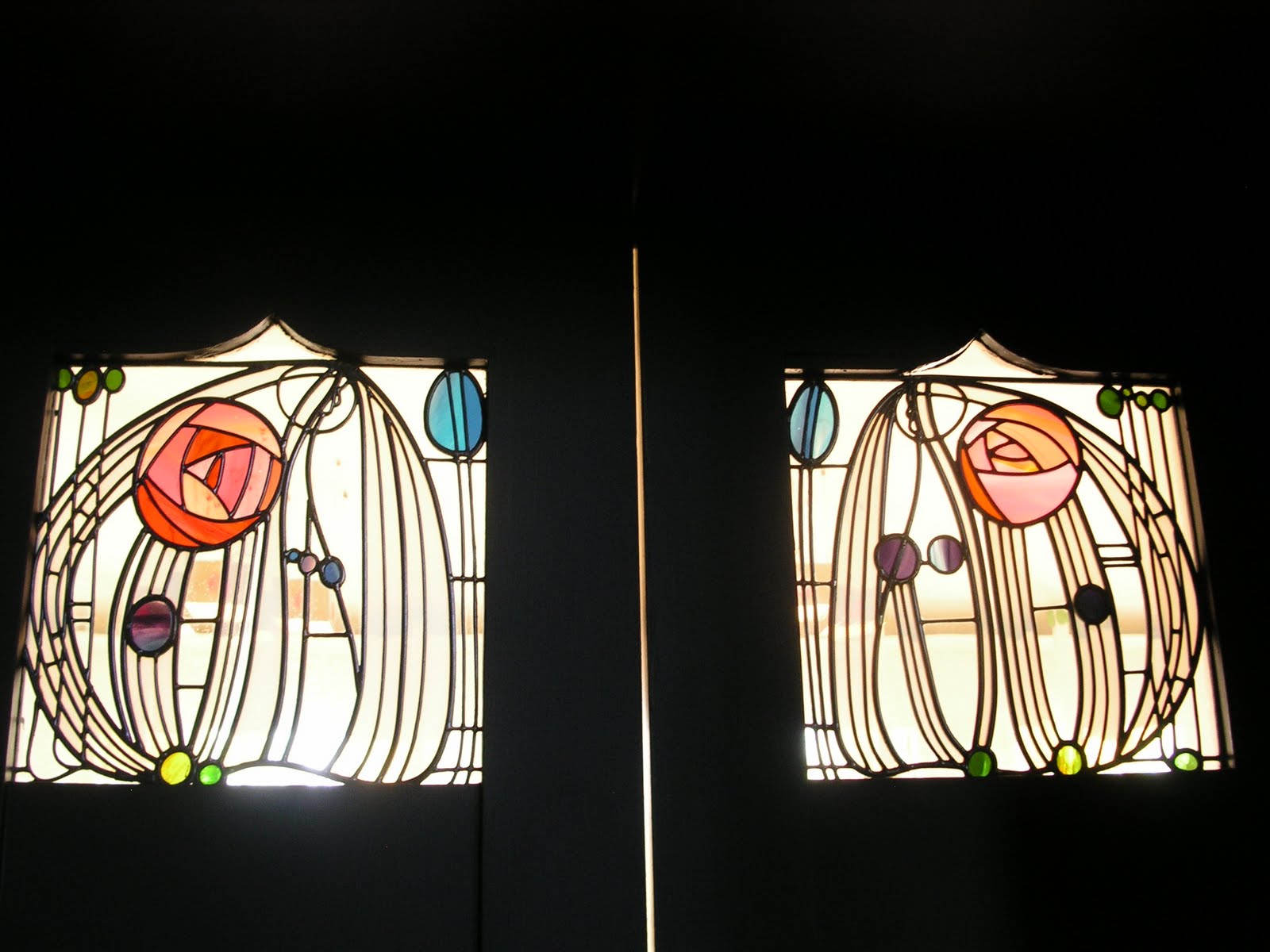
Charles died in 1928, poor and virtually forgotten, and Margaret died in 1932. Their marriage was a true love story. Today, people world wide value the design aesthetic we today call "Mackintosh" There are many other sites in the Glasgow area that feature the architecture and interiors of Charles Mackintosh. The House for an Art Lover might be a good place to start. 

Tulips in the walled garden outside of House for an Art Lover
The Burrell Collection, is  housed in a museum in Pollok Park. Sir William Burrell amassed great wealth in the shipping business and spent his money on collecting artwork from all over the world. However he started collecting art at age 12. he collected his entire life until his death at age 96. He considered the tapestries to be the most important part of his collection. There are over 200 in the collection. The family gave the entire art collection to the city of Glasgow.  

Liz Gibson, an enthusiastic volunteer docent, guided us through the tapestries and embroideries on display. The collection includes large and small tapestries from Flanders, Brussels, and France. Most of the tapestries are currently not displayed as the museum is in the process of cataloguing and studying  them for a scholarly publication. 

 “Four Scenes from the Life of a A Virgin” was woven in Switzerland in the late 1400's and woven for the church. It has wonderful little details like the fact that the angel's eyeswere woven cross-eyed!
Large tapestries were woven in Flanders and France. Brussels was a major weaving center in the 1500's. By this time the royalty were commissioning most of the tapestries. Henry VIII was reported to own over 2000 tapestries. “Prudence Arriving at the Temple of the Divine Wisdom” approximately 5 x 12 meters, was woven on its side which made it much stronger when hanging. The weavers sat side by side following a cartoon. They only had 2 dozen colours of yarn at that time, so they used a hatching technique which created 3rd colour from two yarn colours and added dimension to the figures.
Burrell also collected 350 embroideries. English embroideries were the best of the day during the Stewart and Tudor periods. Men and women could earn a tremendous wage in the profession.  Mary Queen of Scots was an amazing embroiderer.  I   could not take photos of the embroideries due to low light.

Walking around the park, which has a large herd of Highland cattle, flowers, and trees, is a green peaceful retreat in the middle of the largest city in Scotland.http:/www.glasgowlife.org.uk/museums/our-museums/burrell-collection/Pages/home.aspx


Photos in the blog by Nadine Sanders.


Saturday, May 21, 2011

Day 14 To Stirling and Home


In Glencoe
On the last day of our tour Coach A traveled from Skye to Stirling through the stunning scenery of Glencoe glen. A number of movies, including the third Harry Potter, have used this area as a set. The tragic massacre of the MacDonalds of 1692 continues to give this area of natural beauty a tragic air. Much of the land in the glen is now owned and protected by the National Trust of Scotland.  The clouds parted briefly to see the top of Scotland’s tallest mountain, Ben Nevis, and we stopped at the Commando Memorial.

Our wee Rabbies mini-coach, second from the right, which can negotiate tiny 'B' roads and go places these other big beasts can not follow
 Coach B traveled south from Inverness and both groups met at Stirling Castle.
Stirling Castle is the site of many famous battles. It rises out of the lowlands as the entrance gate into the highlands. From the castle you gaze across fields where many battles have taken place in earlier history and look across to the Wallace monument.
Wallace Monument in the distance
 The Romans originally built the only road from south to north that ran right through this area where the Firth of Forth meets the River Clyde Basin. That is why it was a strategic site for holding or conquering the land. Many different buildings and fortifications have stood on this site since the 1200’s. The castle has been rebuilt at least eighteen times over the centuries. We had a very keen guide this year who pointed out many fascinating details about the buildings, statues and history.
 Historic Scotland's website will fill in the details of this historic place. www.historic-scotland.gov.uk
Statue of King James V dressed as a commoner at the corner of his palace. At one point, all the buildings at Stirling Castle were painted the golden color of the great hall, seen at left.
We have the current renovation of King James V palace to thank for the Unicorn tapestry project. Historic Scotland is working with the West Dean Tapestry studio to recreate the 7 tapestries in the “Hunt of the Unicorn” series. The originals with the blue background are in the Metropolitan's Cloisters Museum in New York City. The other series with the red background are the Cluny Museum in Paris. You may enjoy reading Tracy Chevalier’s excellent historical fiction book called “The Lady and the Unicorn” based loosely on the weaving of the original tapestries.
Louise Martin, head weaver at Stirling Castle
Since records show King James had over one hundred tapestries in his palace, very likely including a version of the Unicorn tapestries, the Hunt series was chosen to be made anew. Louise Martin, the head weaver of the project, gave us an in-depth look into the scope of this amazing project. We were extremely lucky to see the 4 tapestries already completed are hanging on display at the Chapel Royal. Right after our visit, workers erected scaffolding to remove the tapestries. Later this week the tapestries will be clean and then rehung in King James Palace which opens to the public in early June.
 
To render the full-scale design and cartoon, the head weavers go to New York to the Cloisters. They have access to within one millimeter of the original tapestries but cannot touch them. They figure out yarn colors and make a detailed plan for each figure and motif in each tapestry. Working from full size color copy, they make an acetate tracing of the tapestry. Then from this they make a paper cartoon.
#1 'The Start of the Hunt' woven with 100 colours of yarn and a 'thousand flowers' backbround at West Dean studio.
 Samples are woven to work out specific techniques to achieve desired effects. The wool yarn is all dyed at the West Dean studio. Instead of silk, pearl cotton is being used for the shiny parts as it has longer color fastness. Historic Scotland requires that the materials being used in the tapestry hold up for 250 years.

#2 'The Unicorn at the Fountain'
 Weaving the tapestries is not a matter of copying. First, the new tapestries are being woven 10% smaller than the originals to fit in the space in the palace. They are weaving with fewer EPI (ends per inch) in the warp because it would take too long and cost too much money to weave them at the original finer warp set. (A patron in her eighties is financing the project.) Also, the head weavers have to train the weavers who come in to weave each tapestry. Although all experienced tapestry weavers, they need to understand the specific techniques and develop nuances of skill.

The third tapestry in the series 'The Unicorn Leaps from the Stream' is currently being woven at West Dean Tapestry Studio. The fifth tapestry in the series will be woven last at the Stirling studio.
#6 'The Unicorn is Killed and Brought to the Castle'  There are seveneteen dogs, 108 colours, and two scenes depicted in this tapestry
About 25 weavers total will have worked on the series by the time it is completed (including Joan Baxter whom we visited previously.) Each weaver has to leave their own individuality and style behind and try to get into the mind of the original weavers as they work. Getting this inside look at the current project is really special. The scope, historical accurateness, detail, and dedication is amazing.
#7 'The Unicorn in Captivity'   Seven different colours of yarn are used in weaving the unicorn
A temporary studio was built on the north end of the castle for this project. Visitors to the castle can view the weaving but are not permitted to talk to the weavers or take pictures while they are at the loom. The weavers are currently working on fourth tapestry in the series, "The Unicorn at Bay” on which the weaving started February 6, 2008 and will be completed in summer 2011.

It is humbling to realize that it will take 3 highly skilled weavers working 7 days a week, 3 ½ years to complete this current tapestry. Another tapestry in the series is being woven at the West Dean Tapestry studio 500 miles away in England. The entire project will be completed in 2013 when the whole set of tapestries will hang in King James V Palace. http://www.westdean.org.uk/tapestrystudio/commissions/historicscotland.shtml
The resident blogger
Travel is a wonderful teacher. We leave our framework of our normal, everyday lives, and are thrust into a culture, which may not seem so different from our own. But as we talk, eat, ride on ferries, visit museums, breath in deeply, we learn in subtle and sometimes not so subtle ways, that every culture has unique things they offer to the world. Scotland has always offered her friendly people and welcoming nature to me and I believe my travelers felt this too. 
At Skaill Bay, Orkney
We fly back home and leap back into our lives, but we are not the same. Our being has been touched and changed. I always come home so thankful for the affordable food, fuel and energy we are privileged to have in North America. And I’m reminded to give back the hospitality to visitors in our communities and homes that we received in Scotland. If you’ve felt Scotland calling you, I welcome you to come with next year April 10-23, 2012. I’ll have the updated tour information available on my website sometime this June. Thank you for blogging along on the journey!


Day 13 Northeast Scotland


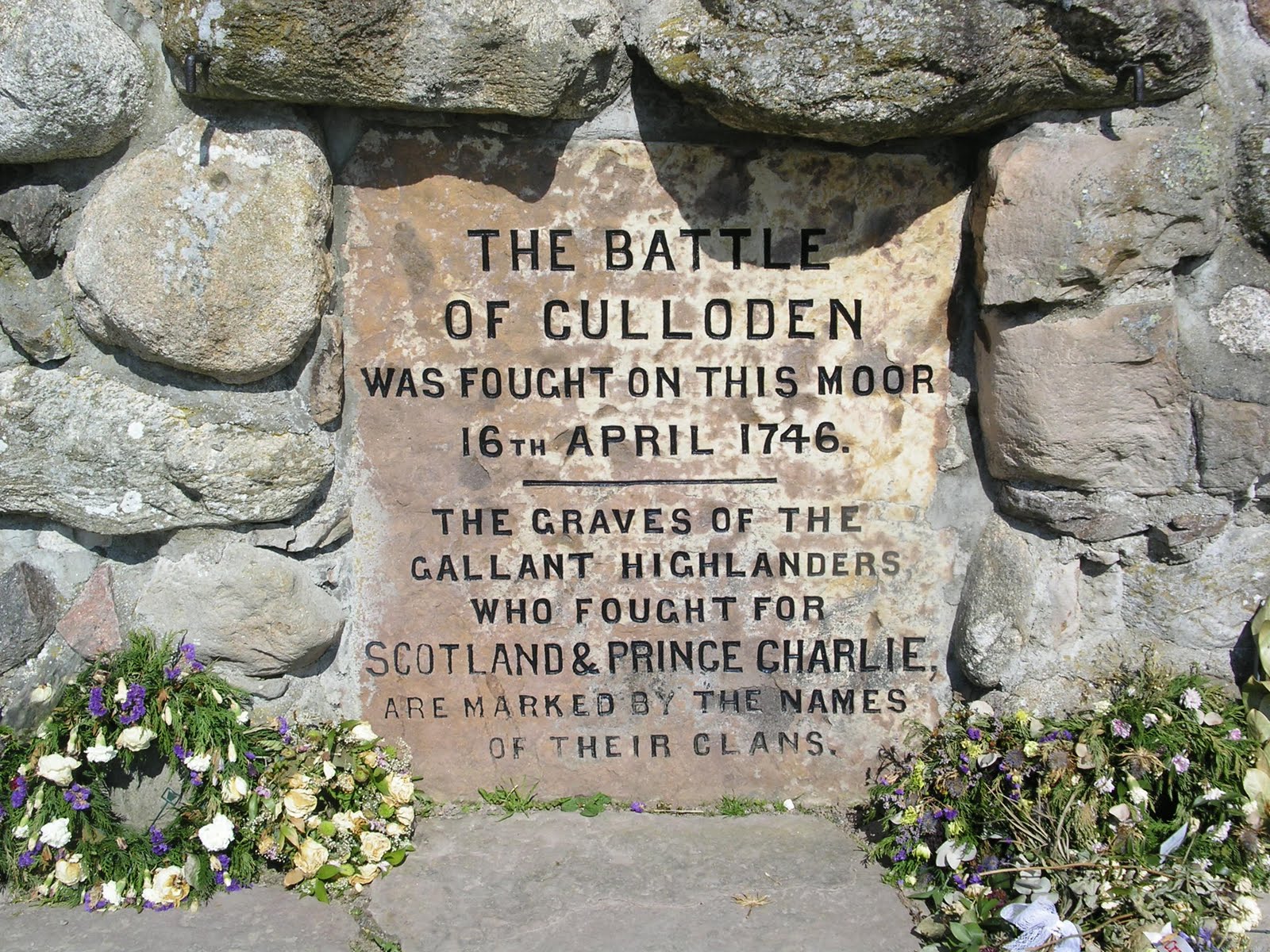
Culloden Battlefield Visitor Centre lies just a few miles from Inverness, the capital of the Highlands.  This famous battle lasted just 45 minutes and was the end of the Jacobite uprising. The visitor center tells the story of the years of political events leading up to the battle from both the government and the Jacobite viewpoints. The centre overlooks a flat field where on April 16, 1746, the Duke of Cumberland sent Bonnie Prince Charlie fleeing.
The battle field is marked with red flags showing the position of the government forces and blue flags for the Jacobite army.
Not only were the Jacobite forces massacred that day, after the battle, Cumberland, know as "The Butcher" ordered all Jacobite supporters in the Highlands hunted down and slaughtered after the battle. http://www.nts.org.uk/Culloden/Home/


For a musical interpretation, listen to the McKassons "Culloden" on their recording "Tripping Maggie" http://www.themckassons.com/recordings.htm


Just a few miles off the A9 along the River Brora sits the studio of Joan Baxter, tapestry artist. Joan learned to weave tapestries from Archie Brennan in Edinburgh. She has been weaving tapestry commissions for over 30 years. She wove at the West Dean Tapestry studio and at the Victorian Tapestry Studio in Australia before opening her own studio. Her work can be seen in major tapestry exhibitions around the world.
Joan Baxter, tapestry artist and teacher
 Joan is inspired by the land and landscape. She and her husband live on a seven-acre nature preserve passed down from her family.  One can see the influence of the land in her traditional and mixed technique tapestries. 

Joan loves mixing colors, "Why use one colour when two will do?" 

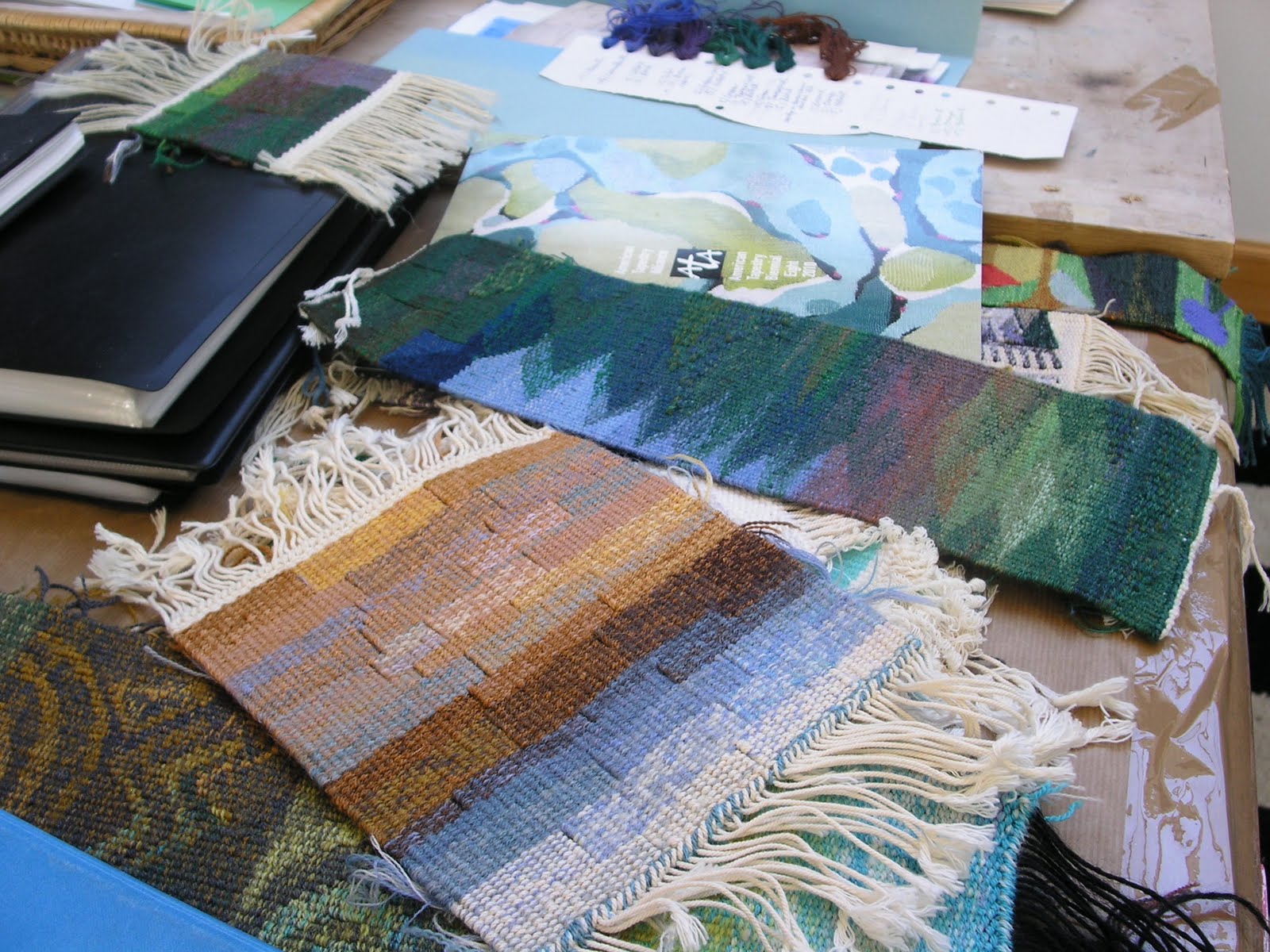
She often works from a concept and digital photo.  She makes loose sketches and often draws and paints on top of a printout of the photo. She prefers not to use a detailed cartoon, so the work can develop as she weaves. Joan also enjoys teaching tapestry students. http://www.joanbaxter.com/
This tapestry recently returned from an international exhibition and just sold! The individual bands of weaving were inspired by the folds of a kilt.
Current work on Joan's loom inspired by the past two harsh Scotland winters

Joan's husband, Steven Clark, is a blade smith, musician, and gardener. He apprenticed with a knifemaker and picked up the skill quite quickly. He told us “I’ve always been interested in doing grubby things in sheds!” 
Steven Clark, bladesmith, gardener, musician
 He likes giving old steel new life as a knife and believes knives should be functional, not just decorative. He made his own forge and uses  variety of materials for the handles including antler. 

Steven only makes knives for commission.  Between caring for the land and creating things with their hands, there is rarely a wasted moment or a missed opportunity for beauty at Ford House.