Tuesday, May 8, 2012

Day 8 Isle of Harris


Tuesday 17 April. The ferry departs Uig on Skye to transport travelers on a 90 minute sea crossing  to the Outer Hebridean town of Tarbert on the Isle of Harris. 
Caledonian Macbrayne ferry
Terry Bloomfield, a current Harris Tweed weaver, generously lets us visit his Tarbert studio each year.
Terry shows Lynn the draft
Weavers must complete a 12 week weaving course to prove their skill and competency before going to work for the industry. There are currently 100 weavers on the island that supply the industry weaving on Bonas Griffeth double wide looms. The looms are powered with a pedals like a bicycle. Instead of a shuttle, a rapier travelers through the weaving shed carrying weft yarn back and forth.
Rapier action on the Bonas Griffeth loom
Thirty years ago, 700 tweed weavers worked on the islands. Today the mills in Shawbost and Carloway provide the warped beams to the  tweed weavers.  1 beam of warp for four, 75 meter tweeds is delivered to his weaving studio. Normally, it  takes 2 weeks to weave off the beam. The fabric is taken back to the mill for finishing and marketing. Much of the tweed is sold to Germany. Terry taught  6 new students to weave on the doublewidth looms last fall.  The looms were supplied for them during the coursework. The students lease the looms when starting their own tweed weaving studios. Read more about the history of the industry at http://www.harristweed.org/


The Harris Tweed shop sits right next to the ferry terminal in Tarbert. The whole island was saddened at the death of Katie Campbell in2011. Here is a photo of Katie,  her daughter Catherine, and granddaughter I took at her shop in 2009. Katie had woven tweed for over 40 years. She and her sister Marion grew up at the foot of their father who was also a tweed weaver. Grannie had 11 girls who all spun. My mom died young. There were 4 of us girls and Dad bought a Hattersly Loom. We went to sleep to the click clack of the loom. It was lovely. It was safe.--Katie Campbell

The late Katie Campbell and family.


Harris Tweed Shop with the orb sign
Catherine keeps her Hattersly loom humming along turning out colorful contemporary and traditional tweed cloth. Besides yardage for sale, the Campbell's tweed is   sewn into caps, handbags, jackets, teddy bears, seals, etc.  http://www.harristweedandknitwear.co.uk/family.html

Bolt of Harris Tweed
Leaving Tarbert, we drive south. Harris is known for its sandy beaches. Luskentyre  shows dramatic beauty in all kinds of weather. Today, in an approaching rain shower.  The white sand sets off the incredible blue colors of the water making it seem like a movie setting for “Paradise Lost.”

This hairy coo was grazing at the entrance to the beach path

Mary and Marsha lead the group to the beach

Our driver Karen was the only one hearty enough to enter the water

Patterns of soil swirled in the sand by the tide


Luskentyre Beach
At an unlikey gallery, the upstairs of the An Clachan grocery store in Leverburgh on the southern tip of Harris, is displayed a wonderful labour of love. Gillian Scott-Forrest instigated the Millenium Project. A series of hangings was designed, one for each part of the island.

Gillian Scott-Forrest


The tweed fabric and the wool yarn used for the pictorial embroidery was hand dyed using plant dyes. Of the 1600 people living on Harris, 90 were involved in the project. The images on each hanging depict both history and current events from each area of the island. Each of the 8 panels are 5 fett by 2 1/2 feet.


Until the project, called the Harris Tapestry, finds a permanent home, you can get your gas, buy your groceries, have breakfast, and learn of the rich history of the people and the island all in one stop. http://www.harristapestry.co.uk/
  
St. Clements Church is a wonderful structure, built in 1520 by Alexander MacLeod. In the 19th century it was being used as a cow barn until Lady Dunmore restored it in 1873. There are 3 crypts in the sanctuary featuring intricate stone carvings. The graveyard surrounding the church holds many MacLeod graves as well as other local families from through the centuries. The accoustics are stunning and I love to sing in this haunting church. http://www.leverburgh.co.uk/stclements.htm

Alexander MacLeod's tomb features spectacular carvings


Day 7 Aberdeenshire to Skye


Monday 16 April. This was our first day of mostly driving. But with the sky sunny, and the scenery glorious, we stopped many times to soak in the view.
Lochcarron
We drove down the A890. Strome Viewpoint overlooks the sea loch, Lochcarron. For forty years Strome was the railway terminus for trains connecting to the Hebrides bound ships. It was not until the 1960's that a motor road was built around the Loch. In the 1970's and 80's, this loch was the site of a huge industry that built oil rigs for the North Sea oil drilling sites. Today oil rigs are built in Asia and no visible remnants of that industry remai here. It was such a fine vista, I snapped shots of the blissful travelers.
Marta
Barbara
Cathy
One used to have to sail to the Isle of Skye as did Bonnie Prince Charlie in fleeing from the government forces after the Battle of Culloden. In 1995, the bridge was built forever changing the island. The rest of the pictures tell of our afternoon on Skye.
Skye Bridge with the Cuillin Mountains in the background

Our driver/guide Karen,  took us to some of her favorite spots on the Isle of Skye.
Fairy Castle in Fairy Glen
Carol and Ray hiking up to the "castle"
Almost there!
Many cairns and modern stone creations dot Fairy Glen
Where the fairies swim
Add caption 
Judy peering over the edge
Kilt Rock
Our first view of peat banks


Day 6 Workshop Day in Oyne


Sunday  15 April  We had a day of snow showers for our workshop at the rural setting of the studio at Touched By Scotland in Oyne.


Robin and Jan have studio space for classes, in addition to their large gallery full of metal, jewelry, paper, fiber, painting, glass, ceramics,  wood, and artwork all made by UK artists.http://www.touchedbyscotland.com/

I always provide a workshop on the tour. Since many of the travelers are makers, it allows us to take a break from traveling and enjoy a day of creativity.


Elaine Lindsey is a local artist who has worked for the past 27 years reviving the Scottish forms of straw work. Today we soaked in the history and learned some technique of Scottish straw work from her. http://www.somethingcorny.co.uk/
Elaine has been working with wheat, oat and rye straw for nearly 27 years. Her work is very varied, from making a traditional Skeklar costume for an exhibition in Los Angeles to producing straw accessories for London fashion Week and photo shoots for magazines. She also makes props for theatre and television. Elaine loves researching and reproducing traditional designs but also enjoys designing her own contemporary pieces. Elaine gets great pleasure out of passing on her skills through workshops, demonstrations and talks.She teaches all over Britain and has taught abroad. In 2010 Elaine was invited to teach for a week at the John Campbell Folk School in North Carolina. Elaine is a member of the Guild of Straw Craftsmen and the National Association of Wheat Weavers. http://www.nawwstrawart.org/

Carol learning how to make a proper bow that stays flat
A gifted teacher, Elaine is so enthusiastic and knowledgeable about many kinds of straw work from around the world. She is always learning new things herself and this shows in the vast of
array of traditional and contemporary work she produces. Elaine uses wheat for most of her work, although traditionally, straw was used in Scotland for the traditional "corn dollie" work. Elaine's wheat, the "Maris Widgeon variety, is grown in the midlands in England.
Bob working away


Corn Dollie doesn't necessary mean a doll made out of straw. A corn dollie just means that it is straw work that still has the "ears" or heads of the grain incorporated in the piece. "Dollie" comes from the word "idol". There are many different stories about the significance of the last sheaf of corn (corn is the word used for grain in the UK) harvested from the field. In Scotland the last sheaf, the "cliach", hung in the farm kitchen. The seeds of this were the first planted the next year. It was good luck to have a dollie in the house. You don't need fancy tools to work with straw, just your hands, scissors, straw and cotton string.
Items made by students
One of Eileen's creations
A lonely horse abided in a pasture next to our lodgings in Auchleven. No doubt, after all the carrots our travelers fed it, the horse was sad to see us depart.


Sunday night G & T treated us once again to a house concert of folks songs of Scotland. Trish Norman and Gaye Anthony travel around the UK and Europe performing at festivals. Their voices blend in sweet harmonies while trading off the lead. Trish’s high, clear, lilting soprano is grounded by Gaye’s rich, round alto voice. They accompany themselves with guitars.

They sing songs about the sea,  fishing, and teach us the chorus to their famous haggis song... "how many legs have a haggis, and how high do they fly...!" Their stories and banter interspersed between songs kept us all smiling and laughing and singing along. T Gaye and Trish have made 3 recordings. You can hear their joyful sounds at http://www.shanty.co.uk/G&T/

Thursday, April 26, 2012

Day 5 Dundee, Aberdeenshire


Saturday 14 April, 2012
 To travel from Edinburgh to Dundee, you cross the new Forth road bridge from where there is a fine view the old Forth Railroad bridge. A cantilever bridge, is considered to be the 8th wonder of the world. Completed in 1890, it was the world's first major steel bridge and still carries many trains a day. The bridge has only been closed down 5 days in its history for repairs. http://www.forthbridges.org.uk/railbridgemain.htm


 Dundee lies on the River Tay and is known for 'jute, jam, and journalism.' It was once known as “Jutopolis.” Over 50,000 workers worked in the jute mills. Verdant Works Jute Mill, built in 1833 , was the 16th largest of 61 mills. The last of the jute mills closed in 1997. Verdant Works is now a museum depicting the days when jute was king in this  http://www.verdantworks.com

Jute fiber was brought by ship from India. Large bales were brought to the factories where it was processed, spun into yarn and woven into cloth. Boys only worked in the mills until they were 18, when they were made redundant.

The visit starts with a film showing the history of the industry. Another excellent film shows current jute industry in India where most of the world’s burlap is woven today. The museum has working machinery that shows the process from the receiving of the raw fiber to the to the finished cloth.  Lilly Thompson guided us through the operation of the machines. She worked in a jute mill for 20 years and ran a power loom. Much of the jute was woven into fabric for sacks and canvas and also used for rope. Here is a simplified synopsis in images.


There are no jute mills left in Dundee. Some of them have been torn down, others turned into housing and others refitted for other industry. But no industry since has matched the success of the jute mills in the 19th and early 20th century. A number of songs tell the stories of working in a jute mill. My group, Straw into Gold has recorded 2 of them, Sheena Wellington’s “The Weavers o Dundee” and Mary Brooksbank’s “The Jute Mill.” You can listen to this second song at http://www.singingweaver.com by clicking on the revolving musical symbol on the home page.
Lilly showing Carol how to tie a weavers knot


A beautiful three-masted, 30’ x 128” ship, the Discovery, sits in the Dundee Harbor. Built in 1901 as a research vessel, it was designedfor the artic with a 27” thick hull comprised of 3 layers of pine, oak and fir. You can see the saltboxes in the hull that were filled with salt and pushed into the hull, like drawers, to absorb any excess moisture between the hulls. The ship was powered by a double expansion engine, made in Dundee, which was powered by two boilers. These boilers were fed coal. For the first Antarctic voyage, 400 tons of coal was stored in the hold and 40 tons on the deck.


Captain Robert Falcon Scott led an expedition of 47 men to the Antarctic for scientific research. Scott desperately also wanted to be the first to reach the South Pole. The The crew included 37 sailors, 5 officers and 5 scientists. The scientific study focused on the five areas of geology, meteorology, magnetism, zoology and biology.


With space for only 18 sleeping hammocks in the crew quarters, the men worked and slept in 12 hour shifts. The main meal was as noon. Each crew member was given 1 glass of rum with lunch. In New Zealand the ship took on 40 sheep that were slaughtered and hung frozenon deck. The diet was supplemented by penguin, sea birds and seals. 100 pounds of dry mustard was in the ship’s pantry to disguise the bad taste of the penguin and other birds. Every person was given a dose of lime juice each day to prevent scurvy.
 Officers had a finer sleeping and galley area, but it was also the coldest place on the ship. The officers would wake up with their blankets frozen to their beds. When the ship reached the Antarctic, they became frozen in sea ice and remained there for 2 winters.The scientists conducting research made significant discoveries in the areas of plant and animal life, climate, and geology. Hartly T. Forrar studied the geology of the Antarctic and published the first description of Antarctic geology in 1903. Today, that book has been modified, but not replaced.
Our guide has volunteered on the Discovery for many years.
During the Southern Sledging Journey of 1902-1903, Scott, Shackleton and Wilson traveled for 95 days attempting to reach the pole via foot. The 19 dogs brought on the journey to pull the supply sled all died. The mission was unsuccessful. In Feb 1903, the pack ice broke up freeing the Discovery to sail back to Scotland. Scott did reach the South Pole on his second journey but was not the first. Norwegian explorer Roald Amundson beat Scott by 33 days. Scott died while sailing back home. http://www.rrsdiscovery.com
Bob and Ray on deck

We dined tonight at Gadies, the restaurant attached to Touched by Scotland gallery in Oyne. Robin and Jan offer food that looks beautiful and tastes delicious. They utilize many of the agricultural products from the fertile land of Aberdeenshire. http://www.touchedbyscotland.com/gadies.php
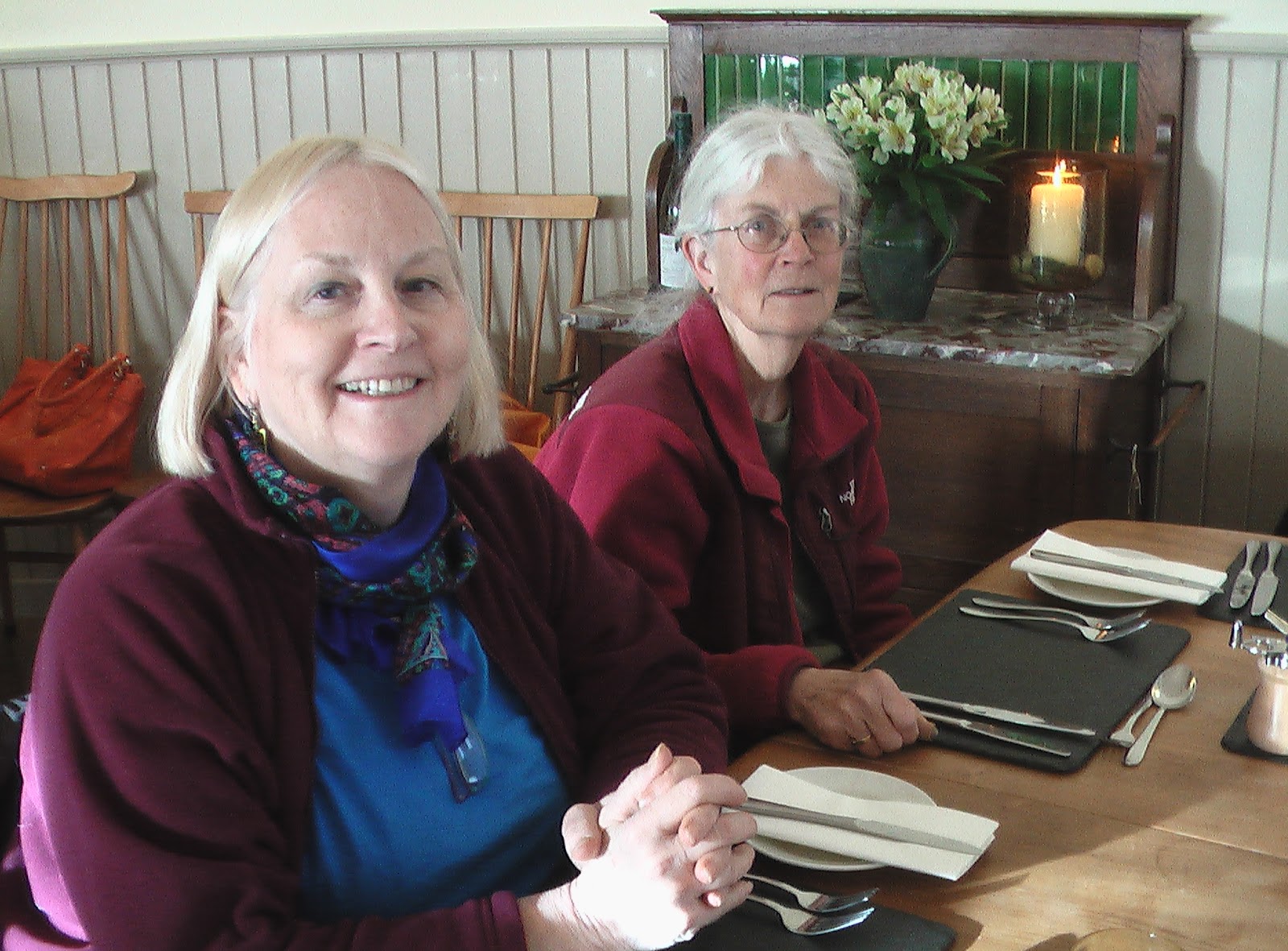
Judy and Margaret awaiting the feast

Ray, Mary, Bob

Carol, Cathy, Marta

Barbara, Marsha, Lynn