Wednesday, May 14, 2008

Day 12 Isle of Harris


At an unlikey gallery, the upstairs of the An Clachan grocery store in Leverburgh on the southern tip of Harris, is displayed a wonderful labour of love. Gillian Scott-Forrest instigated the Millenium Project. A series of hangings was designed, one for each part of the island. The tweed fabric and the wool yarn used for the pictorial embroidery was hand dyed using plant dyes. Of the 1600 people living on Harris, 90 were involved in the project. The images on each hanging depict both history and current events from each area of the island. Each of the 8 panels are 5 fett by 2 1/2 feet. Until the project, called the Harris Tapestry, finds a permanent home, you can get your gas, buy your groceries, have breakfast, and learn of the rich history of the people and the island all in one stop. http://www.harristapestry.co.uk/

From Harris we drove up to Tarbert and over the bridge to the island of Scalpay to visit Sheila Roderick and John Finlay Feguson at croft #37. Scalpay island has 40 crofts in all. Sheila and John have been farming here for 30 years. The farm goes back in their family to 1890. To make a living, the industrious couple have 100 lobster creels, 40 Hebredian black sheep, a flock of ducks, guineas, chickens and raise turkeys for the Christmas market. The photos show a Hebredian lamb and ram and also the end result of the spun fleece. On of the travelers, Doreen, purchased some of the fleece and was clever enough to have brought along a drop spindle. She started spinning that this very afternoon!

The couple still harvest their own peat and grow potatoes in lazy beds. On their Hattersly loom, they weave linen cloth and linsey-woolsey. Some of their fabric ends up in costumes for movies and the theater in London and NY. Success does not come without long hours and hard work but you can hear the love of this rural life in Sheila’s voice. http://www.scalpaylinen.com/

We all enjoyed sitting around refurbished sewing machine tables to eat lunch at First Fruits Tea Room in Tarbert. Most of us didn't have room, but if you visit, be sure to leave room for their home baked desserts.
Tel: 01859 502 439

Just down the road in Tarbert we visited Terry, a current Harris Tweed weaver. Today, weavers have to complete a weaving course to prove their skill and competancy before going to work for the industry. There are 150-200 weavers on the island that supply the industry weaving on Bonas Griffeth double wide looms that are driven with a pedals like a bicycle. Due to some politics with the newish owners of the mill in Stornoway, there has not been any warps given out to tweed weavers for several months now. And then there is the issue of how to keep tweed fabric in the eyes of the fashion industry. Read more about the history of the industry at http://www.harristweed.org/

Winding our way back to Leverburgh via the Golden Road, we happened upon Katie Campbell's studio and shop in Plochropol, Harris Tweed and Knitwear. Katie has been weaving tweed for over 40 years. She and her sister grew up at the foot of their father who was also a tweed weaver. "Grannie had 11 girls who all spun. My mom died young. There were 4 of us girls and Dad bought a Hattersly Loom. We went to sleep to the click clack of the loom. It was lovely. It was safe." Katie and her daughter keep two Hattersly looms humming along turning out colorful contemporary and traditionl tweed cloth. Besides yardage for sale, they have their fabric sewn into caps, backpacks, handbags, jackets, teddy bears, etc. http://www.harristweedandknitwear.co.uk/family.html

We capped off our 2 days on the islands with a celebration at Rodel Hotel. http://www.rodelhotel.co.uk/ Donnie and Dena MacDonald have converted a former school into a hotel and restaurant where fresh and simply prepared local fare is served. The seafood, some hand dived for just down the road, was the best we have eaten on the trip, as Jan's face concurs.


Bill Lawson, local history, genealogy expert and author of many books, joined us and told us about the history of the tweed industry and the island. http://www.billlawson.com/Then is wife Chris, and the rest of the "Luadh" group did a wualking for us. They thumped, rubbed and passed a length of tweed around a table while singing waulking songs in Gaelic. Waulking was the process used to full and finish the cloth once it came off the loom. All was very orderly and efficient until they asked for volunteers from our group. After that not much waulking but a lot of laughter was acheived!

Day 11 Ullapool, Lewis, Harris


The ferry took us to the Outer Hebridean islands of Lewis & Harris today. But before leaving Ullapool, some of the group checked out Strandlines and The Unlimitied Colour Company, two shops that carry handknits, and other textiles from the UK and around the world.

We journey the 2:45 minutes by ferry because this is the land of Harris tweed. Some of the group productively knit away with yarn they purchased on the trip. Others used the time and comfortable reclining ferry chairs to catch up on sleep!

The definition of Harris tweed: made from the wool of Scottish sheep, spun in the Outer Hebrides, woven by hand, and finished in the Outer Hebrides. When the potato famine hit Scotland 1845-47, Lady Dunmore took the tweed the islanders were weaving, traveled the world, marked up the price 20x and came back and gave the weaver all the profit. Harris tweed became famous worldwide and the demand kept growing. Originally the tweed was naturally dyed. Crotal, a lichen, gave light to dark rusty color. Spinning mills came in 1907 and all the yarn was then aniline dyed.
In 1926, the Hattersley Loom greated increased the productivity of the weavers. The looms had hands free flying shuttle mechanisms and were powered by stepping alternately on two pedals.

This is the loom you see Donald Macarthur, weaver at Gearranen Blackhouse Village weaving on as we stepped into the past to All the handweavers in our group marveled at the wonderful hands free, shuttle mechanism sends up to 6 different shuttles flying across the warp. The warp Donald was working on was 33" wide set 18 EPI with 18 PPI. In one and a half days, 100 yards could be woven on a Hattersly loom. http://www.gearrannan.com/

Most of the 9 houses at Gearannen were built in the 1850’s. In 1989 a trust was formed to restore the houses and the village opened in 2000. When the blackhouses were built, they were long structures with an open plan. Animals lived and one end and people lived at the other. The roof was thatched. Blackhouses were very similar to the much earlier Viking long houses. Most had open fires in the middle of the living area. Medical officers required that dividing walls and windows be put into the houses by the turn of the century. Some also put in chimney’s. 50% of the rurual population on the island still lived in blackhouses up to 1939. Mary, our guide, taught us some Gaelic words and offered us these thoughts. “The people who lived in these houses were penniless. But they had a lot of thing we need here now…community spirit and tolerance. We are losing the richness of simplicity.”

Dun Carloway Broch rises up on hill in the midst of current modern day farms. Perhaps ¼ of the original broch still stands. But the impressive stonework remaining gives a good idea of what life in this multi-storied landowner’s home from the Iron age was like. http://www.stonepages.com/scotland/duncarloway.html


The sky clouded over by the time we reached the Callenish Standing Stones, but I think that light makes them all the more impressive. A small visitors center tells the history of the area and surmises about the why and how of the circle. The cross formation of stones intersecting this circle sets it apart from stone circles we saw on Orkney. Many other smaller standing stones line the west coast of Lewis. http://www.undiscoveredscotland.co.uk/lewis/calanais/index.html


Harris lies south of Lewis. The islands are actually connected by the road, but as you reach Harris, the hills rise up and the landscape becomes much more rocky. Harris also has brilliant sandy beaches. We stayed in the vicinity of Leverburgh tonight and the next to get a better feeling for this island where farm animals far outnumber the people


Tuesday, May 13, 2008

Day 10 St. Margaret's Hope to Ullapool

Nature provided our venue of the day. We departed St. Margaret’s Hope on South Ronaldsay Orkney on the 8:00 a.m. ferry and pulled into Ullapool just before dinner. This drive across the North and Northwest of Scotland was no ordinary journey. This is the least populated, most remote and rugged and least visited area on the mainland…my favorite landscape in all of Scotland. Once past Thurso, it is mile after mile of rocks, beach, hills, water, heather, birds and grazing sheep. The road often goes to one lane. At Dunnet Head, the North Sea meets the Atlantic Sea. We were blessed with sunshine that added to the richness of the color of the sea and stone. Uarda, dressed in her handwoven suit, chose the right outfit for this breezy day.


Just outside of Durness, we stopped at Balnakeil Craft Village. www.durness.org/Balnakeil Once a military base, it was taken over by hippies when the military left and now is inhabited by small shops and craft studios. I told the group that the reward for all this sitting and riding today was dessert at Cocoa Mountain, the gourmet Aardvark shop at Balnakeil. They specialize in truffles with unique flavours like strawberry pepper, and hot chocolate. You can't miss this heavenly stop if you like chocolate. http://www.cocoamountain.co.uk/

Finally some rain by the time we passed Ardvreck Castle ruins. I keep telling the travelers that the these views are even better in the rain! We stopped at Highland Stoneware Pottery shop in Lochinever. The driveway and garden of the shop proved very entertaining with large stones, an automobile, a gigantic concrete sofa, all covered with broken pottery. http://www.highlandstoneware.com/ Before heading on, make sure to drive into town and get a homemade pie from the Lochinever Larder. Their savory or sweet pies are in such demand, they post them around the country. http://www.piesbypost.co.uk/
Once we reached Ullapool we settled into our B&B's. You see the view here from my room. No one ever wants to leave this idyllic spot. A hearty thank you to Charlotte at Dromnan Guest House http://dromnan.com/
who always goes out of her way with hospitality, this time offering to run a load of wash for us. A fine reprieve from handwashing those socks one more time.
Just down the road from our B&B’s at Ullapool, we enjoyed a delicious meal at the Royal Hotel restaurant. Here you can see the entire group relaxing. You may have noticed that I talked a lot of about food today. I think travelers are happiest when not only their eyes are delighted by scenery, their minds are expanded by history, but when their stomachs are satisfied. However, after 10 days of travel, we have eaten every kind of potato and have started pleading with the servers, "please don't bring so many!"

Day 9 Mainland, Orkney

The big island, or as Orcadians call “mainland” is home to numerous stone circles and structures dating back as far as 5000 years. Nowdays, the 17 or the 65 islands that are populated are home to 20,000 people, 100,000 beef cattle, 68,000 sheep and one fishing fleet, on Westray.

Maeshowe, a grass covered burial mound in the middle of a farmer’s field, is that old. You stoop low to walk through the 10 meter entrance tunnel before standing up inside a tall rounded chamber. As in all the sites, some of what the archeologists have found is known fact, other is speculation. Was it in fact a burial mound for the first peoples who build it, or a place of healing and rituals connected to the astrological cycle? In fact, each December the mound is equipped with 3 webcams where you can watch the light in the mound as winter solstice approaches. http://www.maeshowe.co.uk/ Vikings raided the mound in the 12th century and left many runic inscriptions. No great mysteries were revealed however once these inscriptions were translated as they say things such as “Ingibjorg is a beautiful woman.” The lion carving illuminated by our guide, some say is the most stunning carving in the mound.

From Maeshowe you look across a loch and see both the Standing Stones of Stenness and the Ring of Brodgar in the distance. Modern technology has shown that the stone monuments above ground are just the tip of the iceberg of all the ancient stone sites under the earth in this heart of the island. There is currently a new archeological dig exploring a newly found site not far from the Standing Stones.

Michael, our local guide while Richard had a day off, told us tales and speculations about these sites. Stenness means “stone point” and indeed the tall stones still standing are pointed on top, but just 3100 years old. Also known as the Temple of Moon, couples came to perform a marriage ritual which would bind them together for one year and one day. After that period, they would have to come back to the stones to renew that ritual or to break the contract. Thus was their system of “marriage in installments.” www.orkneyjar.com/history/standingstones/

The Ring of Brodgar once had 60 stones standing. Brodgar means “farm by the bridge.” This 2500 year old ring is said to grant the gift of fertilitiy to anyone who runs around it counter clockwise 3x without stopping. Considering the large circumference, this running ritual also meant you were in shape! As we walked the ring, many of us touching each stone, the wind blew us along, urging us to consider what ancient wisdom moved the people to build such impressive sites. What did they know, that we have long forgotten? www.orkneyjar.com/history/brodgar/

Skara Brae was uncovered when a storm hit William Watt’s farm in 1850 and eroded the beach front. The settlement wasn’t excavated however until 1928. This fine example of a stone age community was quite advanced as they even had a sewage sytem and a stone trough area they filled with water and hot rocks to steam the sea life they ate. www.orkneyjar.com/history/skarabrae/

Stromness is the 2nd largest town on mainland Orkney with a population of 2000+. Tait and Style studio sits above the harbour. For 16 years Ingrid Tait has run this company that creates knitted and felted scarves, throws, pillows, and accessories for the high fashion market in London and New York. She discovered a needle punching machine in Yorkshire that was used to make industrial materials. Sensing it could be retooled to work with wool fabric, she acquired the machine and has been punching or felting her marks with fleece or yarn onto commercially woven wool.


As the fashion industry constantly changes, Ingrid is flexible, open to taking commissions from both home furnishing and clothing fashion design houses to create new lines for each season. She is a sought after lecturer and also ofters workshops at the studio. Tait and Style's retail shop is now at The Longship Complex on Broad Street in Kirkwall. Ingrid also runs the jewelry company founded by her mother, Ole Gorie. http://www.taitandstyle.co.uk/ Here is a fabulous hand knit sweater that had Piper's name on it.
The Pier Arts Centre sits unassuming on Victoria Street just off the water front in Stromness. Inside, the centre houses a fine collection of contemporary art. I was delighted to find a number of pieces by British sculptor, Barbara Hepworth. http://www.pierartscentre.com/

Corrigall Farm Museum in Harray is a wonderful example of rural agricultural life on the island. Implements, tools and household furnishings from the 18th-20th century fill the buildings. Inside the buildings are all kinds of fascinating things like a simmon, rope that was made from twising grass, a spoon kaise, for holding cutlery and some North Ronaldsay sheep, the breed that eats seaweed! http://www.orkney.org/museums/

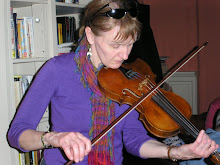
Each Wednesday night, the Orkney Accordian and Fiddle Club practices at the Ayre Hotel in Kirkwall. They welcome listeners and players alike. The night I joined in, they were practicing for their performance at the Orkney Folk Festival. The accordians outnumbered the fiddles, but thankfully some of the fiddlers read music and had notation I played from. The stamina of the players is mighty. After 3 hours I was ready to go to bed, and they kept playing!

The 26th Orkney Folk Festival, is May 22-25 with most concert venues in Stromness. http://www.orkneyfolkfestival.com/

Monday, May 12, 2008

Day 8 South Ronaldsay and Main Island, Orkney

On the short drive from St. Margaret's Hope to Hoxa, Scapa Flow and the distant Martello Tower commands one's attention. 3 such towers were built in Scotland towards the end of the Napoleanic wars. http://www.scapaflow.org/genbtm.htm


It’s easy to see why the blues in Leila Thomson’s tapestries are so stunning. Out the window of her Hoxa studio and gallery the water flashes a brilliant blue in this day of yes, sunshine After graduating from art school in Edinburgh in 1980, Leila came back home and has been designing and weaving ever since. 12 years ago she opened her gallery and now visitors from around the world view her stunning work.
Leila weaves private commissions, working from her own charcoal sketches and full size cartoons. Working full scale from the initial sketch, she feels her woven work comes out more like a drawing. She interprets and chooses all the colors as she weaves blending a variety of fibers. This really gives the tapestries an energy and vitality often lacking in other pictorial textiles. Words and pile texture are also trademarks in her designs. Leila always weaves to music ranging from Metallic to the London Philharmonic, she likes the volume loud. As Leila readily admits “I work in a state of splendid isolation.” After the tourist season ends in September that is. http://www.hoxatapestrygallery.co.uk/

Orkney abounds in artists. One can pick up maps of the Orkney Craft Trail and visit many studios open from after Easter until the early autumn. When I asked one of the Orcadian artists we visited today why the islands are such magnets for creativity, she suggested that it was the influx of artists who came up here from England that got the movement started in the 60’s.

Driving from South Ronaldsay, you cross several of the Churchill Barriers. The British fleet was stationed here in WWII and the barriers were build using labor of POWs to protect the fleet from the Germans U boats. Before the large concrete barriers, salvage ships were lined up end to end and sunk to create the barriers. One German U-boat managed to penetrate those original barriers and sunk a the HMS Royal Oak, with the cost of over 800 lives. Today the area around the seven remaining WWI German sunken ships is one of the top dive sites in the world.

The Italian Chapel stands on the Island of Lamb Holm just over the fourth barrier. Italian prisoners of war who built the barriers and worked in agriculture, were given a Nissen hut to turn into a chapel. Domenico Chichetti designed the chapel and the prisoners worked to decorate and furnish it over a period of 3 years with materials they could scrounge. When the prisoners were released at the end of the war, Chichetti stayed onto finish the work on the chapel. The detailed painting and metal work is a testament to what can be created from nearly nothing when you have dedication and vision. http://www.scotsitalian.com/orkney_chapel.htm
Kirkwall, the largest town in the islands is our home base for exploring the main island. All this fresh air and glorious vistas makes one hungry. We satisfied our hunger at The Reel Cafe. The cafe, music center, and music shop is run by Hazel and Jennifer Wrigley. After being on the road playing concerts since their teens, the sisters now stay close to home and foster the music tradition on the island by teaching lessons and providing a site for weekly sessions for area and visiting musicians alike. At the start of each day on the coach, I play a recording appropriate to the area we are visiting. Today it was Jennifer and Hazel's compositions, The North and the South Ron Reels. http://www.wrigleysisters.com/

You can't be in Orkney without spying old or new Orkney chairs. Locals made these chairs for hundreds of years with materials they had at hand. The chairs combine wood (originally driftwood) for the frame and oat straw coiled and stitched with sisal for the chair backs. We saw the chairs being made first hand at Fraser Anderson's workshop, Orkney Hand-Crafted Furniture, in Kirkwall. Just 23 years old, he is already a master at making Orkney chairs and employees his cousin who fashions the chair backs and several aprrentices who prepare the oatstraw and help in the wood shop. It takes up to 3 weeks to complete each chair. Fraser is honoring the tradition while designing new shapes and styles of chairs, rockers and stools. http://www.orkneyhandcraftedfurniture.co.uk/

Sheila Fleet, is the sister of Leila Thompson, the tapestry weaver we visited this morning. There is no shortage of artistic talent and vision in that family. In 15 years Sheila’s business has grown to 42 employees. Sheila is the chief designer, creating 3 new collections each year. She has done a total of 150 collections so far. She and her son took us on a tour of the workshop while explaining the lost wax method used to produce her jewelry. I found two of the steps extremely interesting. The skill of the master pattern maker who takes each design and hand cuts the metal master has to be exacting. The enamelists also have a painstakingly detailed job, applying the enamel mixture (ground up glass and distilled water) to the jewelry, then curing each piece, one at a time in a tiny kiln on their worktable.
Sheila enthusiasticly answered all our questions and shared her philosophy. “ A measure of success is how you feel about what you are doing. I’m still enjoying myself. You have to look at keeping the balance. Find something you really like doing and you’ll never work again.” If you can't come to Orkney to meet Sheila, she now also has own gallery/store in Edinburgh. Many of the group left Sheila's wearing a peice of jewelry to remind them of the pristine landscape that inspires Sheila's fabulous desigsn. http://www.sheila-fleet.co.uk/
A local friend, Mina Flett, is a wonderful advertisement for the jewelry. Her husband, Arnie has purchased many a gift from the shop. 11 years ago I met the Fletts as I walked off the ferry with a large pack on my back. Arnie drove me around to visit artist studios in exchange for me helping him warp a loom he was given. A retired pipe major, Arnie still teaches piping to dedicated students, and he and Mina entertained us with tunes and poems after dinner tonight. Sitting just a few feet from Arnie as he played tunes he has composed on his chanter, I discovered that he has the unique ability to circular breath as he is playing, a rare gift for a piper.Arnie shared copies of his notated music with one of our group who plays small pipes. Blue skies, incredible art, generous artists, history at our feet, good food and conversation and sharing of music, was this not the perfect day?